
The Problem Isn't Your Brain. It's the Room You're In.
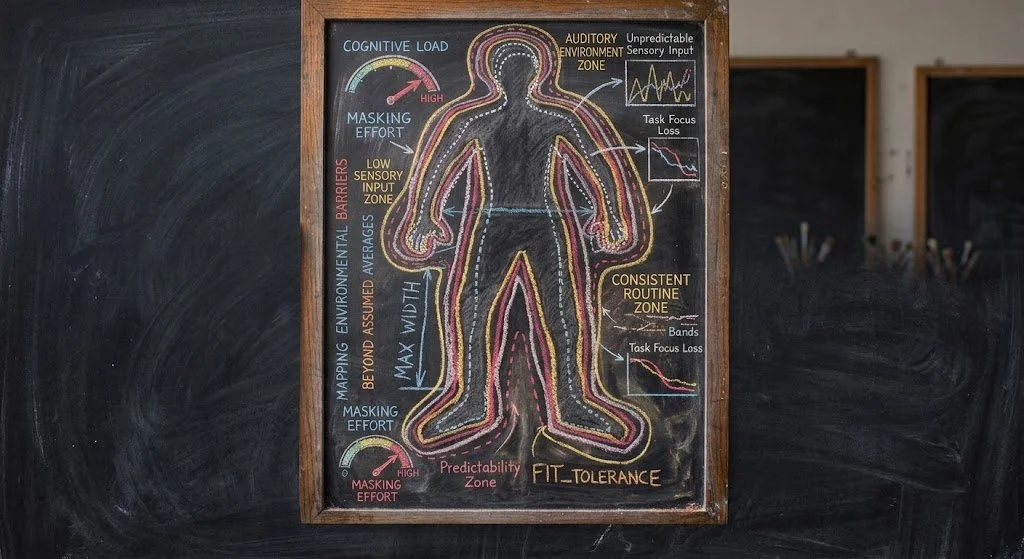
Most of the neurodivergent adults and couples I see in my practice don't arrive asking "what's wrong with me?" in the abstract. They arrive exhausted from a specific, repeated experience: trying, again and again, to force themselves into a shape that doesn't fit - a work culture, a productivity system, a set of unspoken relationship "rules" - and concluding that the failure to fit must be a personal one.
In my practice this usually means autism, ADHD, or the combination - often called AuDHD - though the pattern holds for anyone whose mind doesn't run on the standard operating system society was built around.
I want to offer a different starting point. A brain that struggles to thrive in a rigid, high-demand, one-size-fits-all environment is not necessarily a brain that is faulty. Often, it's simply in the wrong environment. And right now, a great many of us are living and working inside environments that are unusually harsh for a wide range of minds.
The High-Demand, High-Dogma World
Modern life (particularly in cities, in knowledge work, and increasingly in parenting and relationships) has quietly ratcheted up its demands. We're expected to be constantly responsive, endlessly organised, emotionally regulated on command, and productive on a fixed clock regardless of our internal state on any given day. Alongside this sits a fair amount of dogma: rigid ideas about the "right" way to work, parent, communicate, or love, often delivered with real moral weight. Miss a reply within a day and you're "inconsiderate." Forget an anniversary and you "don't care enough." Can't sustain a nine-to-five rhythm and you "lack discipline."
These standards weren't designed with much variation in mind. They tend to assume a fairly narrow band of nervous systems - ones that can sustain even attention across a full day, regulate emotion predictably, and experience time in a linear, felt way. Many ND people simply don't run like that. Attention comes in waves rather than a steady stream. Time is felt more as now and not now than as a smooth continuum. Emotional responses can be more intense and immediate. None of this is a flaw in the machinery - it's a different operating system, placed inside infrastructure built for another one.
What Happens When the Fit Is Wrong
When someone spends years in an environment that doesn't fit them, the damage rarely shows up as "I think this system doesn't suit me." It shows up as shame, self-doubt, chronic overcompensation, and burnout. People build elaborate coping strategies - masking, overworking, constant self-monitoring - just to approximate what comes more naturally to others. And because the mismatch is invisible, the exhaustion gets misread, by the person and everyone around them, as a personal failing rather than what it often is: the ordinary cost of chronic misfit.
This dynamic shows up especially often in couples therapy. Couples feel this acutely. A relationship absorbs a lot of the pressure that a rigid environment puts on each partner. One partner's constant lateness or forgotten tasks aren't processed as "different pacing" - they're processed through the dogma of the day: good partners are reliable, organised, on time. Against that yardstick, a ND partner is quietly cast as the problem, and the other partner as the long-suffering fixer. Neither position is really true. What's often happening is two different operating systems trying to run the same rigid software, without ever questioning whether the software itself is the issue.
Building a Better Fit, Not a Better Mask
This is where I think the real therapeutic work lives - and it's what I mean by neurodivergent-affirming practice. Not training someone to perform neurotypical rhythms more convincingly, but helping individuals and couples work out what actually fits. That might mean redesigning a workday around energy and interest rather than fixed hours. It might mean a couple building their own private agreements about communication and time that quietly opt out of the wider culture's rules. It might mean simply naming, out loud, that a particular struggle was never a character flaw - it was a mismatch between a mind and its surroundings.
None of this means abandoning all structure, or that environment explains everything. But it does mean starting from a more accurate question. Not "why can't I just be normal," but "what would an environment look like that actually worked with how I'm made?" For couples, that question becomes: what would a relationship look like if it were built around how you both actually function, rather than around a borrowed idea of how relationships are supposed to look?
That shift - from fixing the person to examining the fit - tends to be where the real relief begins.
If this resonates with your own experience, or your relationship, I'd be glad to talk it through.