
The Art of Being Understood
Most people assume that communication is something they already know how to do, since we have been talking since we were toddlers. But in the therapy room, one of the most common sources of conflict has a surprisingly simple origin: “I told them”.
"I told him how I felt." "I told her what I needed." There is often an assumption that the words, once spoken, will arrive intact - rather like an email, sent and received, the matter now closed.
Communication does not really work this way.
Describing a landscape
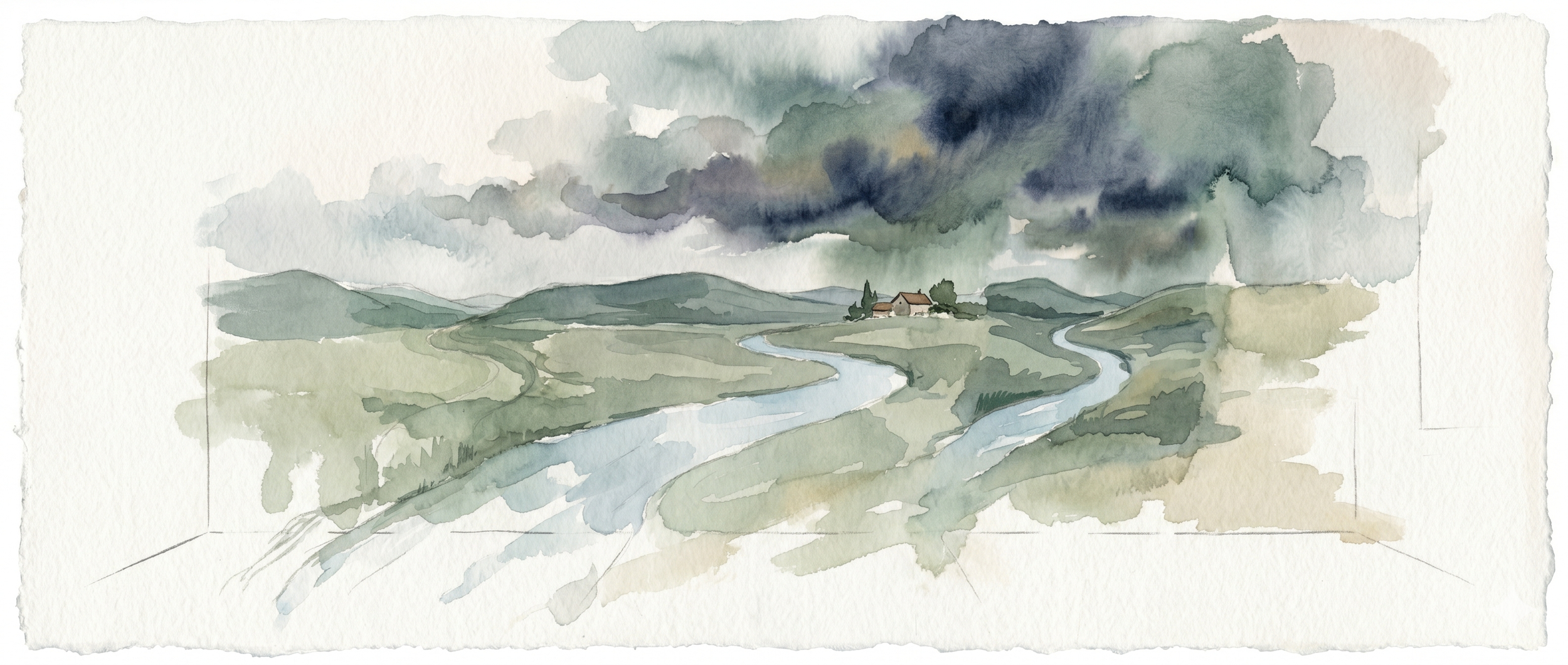
Consider a complex, layered painting - rolling hills, a winding river, a farmhouse half-hidden in trees, storm clouds gathering at the edge. Across the room, your partner sits with a blank canvas and a brush, trying to paint what you describe.
You might say: "There's a house, and it looks a bit stormy."
They begin to paint. Their house becomes a red bungalow, the storm dramatic and central. They feel reasonably confident they have understood you.
But you had been picturing a weathered stone cottage, barely visible, with clouds only just beginning to build at the horizon. The two paintings share very little.
This first pass is usually where the exchange ends. One person has spoken, the other has heard something, and each goes away assuming they are looking at the same picture.
Something more deliberate is required for understanding to actually occur. The listener describes back what they have painted. The speaker looks at this version and notices where it has gone wrong - not necessarily with frustration, but with a kind of interest: that's not quite what I meant.
They try again, adding detail, and the listener adjusts their canvas accordingly. This continues, back and forth, each version bringing the two paintings a little closer together, until the speaker recognises something close to what they had in mind.
This is closer to what communication actually involves.
A fair complaint?
When the listener gets it wrong, the speaker can feel frustrated - “I told you this, why didn't you hear me?”
It is worth pausing on this. Before the frustration settles anywhere, it is worth considering how clear the original description really was. Was the house described in any detail - its age, its texture, where it sat in the scene? Was anything said about the clouds, or the quality of the light? Or was a broad outline offered, with the expectation that the rest would somehow be filled in correctly?
And was there any check afterwards - any moment where the listener's version was actually looked at, before both parties moved on?
Getting it wrong on the first attempt is not really a failing on either side. It is simply what tends to happen when two people, each carrying their own history and their own internal sense of what a house or a storm looks like, try to convey something real to one another. Misunderstanding is the starting point, not the exception.
When the painting is of the other person
There is a particular version of this that calls for something beyond ordinary communication skill - when the landscape being described is not a place or situation, but the other person themselves.
You never listen to me. You always do this. You just don't care.
Here the words carry more than information; they carry weight, and often arrive as accusation before anything else. The listener is no longer simply being asked to paint an unfamiliar scene. They are being asked to hold still while someone describes something unflattering about them, and to remain open enough to actually take it in.
This is where communication can shift into something else entirely. Words that begin as an attempt to be understood can start to function more like arrows. Often the speaker, having reached a point of real frustration, may not notice that the force behind the words has overtaken their original meaning. The intention is rarely to wound - more often it is to be seen - but from where the listener sits, the two can look remarkably similar.
This leaves the listener with a different kind of task. It is no longer simply about accuracy. It involves receiving something that stings, and choosing not to put the brush down - not to defend, deflect, or respond in kind. It means staying with the discomfort long enough to ask what is actually being described underneath it, and what the other person needs them to understand.
This does not come naturally. It runs against most people's instincts. But it tends to be the only way these conversations get anywhere.
It is also why, when feelings are running high and the stakes feel personal, these conversations can be genuinely difficult to navigate without support. Speaking without wounding, and listening without defending, are not easy to manage at the same time, in the same room, when it matters most.
When the listener puts down their brush too soon
There is another pattern worth naming, where the listener hears only the first few words - “there's a house, it looks stormy” - and responds with confidence: “yes, I know, I've got it”. The brush is already moving. Listening has effectively stopped.
This can feel efficient, even attentive. But what is actually happening is that the listener is painting from almost nothing - a fragment, a phrase - and filling in the rest from their own memory, assumptions, and internal sense of the picture, rather than the speaker's.
Sensing the conversation has already closed, the speaker often stops there. There seems little point continuing if the other person has decided they already understand. The remainder of the description goes unsaid, and the painting is completed using whatever the listener already believed.
It is unlikely to bear much resemblance to what the speaker had in mind.
This kind of premature closure is one of the quieter ways listening can fail. It does not look like dismissal, and can even feel like engagement from the outside. But it forecloses the back-and-forth that real understanding depends on.
What this asks of both people
Real communication asks something of the speaker - a willingness to describe rather than assume, and to check rather than simply transmit. It also asks something of the listener - a willingness to stay open, to show what has been heard, and to resist the assumption that they already know.
Neither of these comes naturally. Most of us are busy, often impatient, and accustomed to treating words as self-explanatory. But when the stakes are high - when the landscape genuinely matters - the back and forth is not inefficiency. It is the work itself.
This is much of what the work involves in couples therapy, and often in individual therapy too. If it resonates with something you are navigating, you're welcome to get in touch.